Caesar and the Church
Written in the aftermath of COVID-19 lockdowns, Caesar and the Church (by Anthony Forsyth) discusses how the church should relate to the government, particularly in times when authorities seem to be asserting much power and control over the population.
Among Christians, there is also disagreement on what actually constitutes “Caesar”, and which laws or commands may be considered sinful to follow. In light of these contentions, the popular principle guiding believers to “obey Caesar apart from sin” falls terribly short.
And therein lies the value of this timely book, of which I shall summarise below.
Part One: Biblical Foundations and Principles
Let us start off with acknowledging the most basic principle — all authority comes from the Creator, who made everything in the universe, who is forever sovereign over all creation.
Building on this, our second foundational principle states that God delegates his authority to others; he does not divest himself, but allows the delegate to exercise authority on his behalf. As such, those in positions of power have no cause for arrogance, but should lead with fear and humility, constantly aware of whom they represent, lest they abuse the power entrusted to them.
It is important to note that God sets limits. All delegated authority is:
- Limited in person,
- Limited in sphere,
- Limited in extent.
Taking the first chapters of Genesis for example, we notice God delegating his authority of dominion. Specifically, this authority is bestowed unto humanity, but not angels (limitation of person / people); human dominion is authorised over the earth, but not in the heavenly realms (limitation of sphere); apart from the tree of knowledge of good and evil, humans may eat fruit from all trees, while the killing and eating of animals isn’t permitted — not yet back then, anyway (limitation of extent).
 The hot seat of power.
Here are several more biblical examples of how these limits may be violated:
- King Uzziah (2 Chronicles 26:16-21), in his pride, attempted to burn incense on the altar within the temple of the Lord. This was a job that God had delegated to the priesthood, those from the tribe of Levi; the kings, on the other hand, were from the tribe of Judah. But Uzziah didn’t pay heed about being the wrong person, and became angry when he was confronted by an assembly of priests. He gave up this foolishness only when God struck him with leprosy, which then got him banned from the temple for the rest of his life.
- King Darius (Daniel 6:1-28), in his ignorance, was influenced by his own administration to issue an edict that banned prayer to any god or human other than the king himself for thirty days. Upon hearing this, Daniel continued to pray just as always. In fact, not only did he not comply, but he openly and boldly showed that he wasn’t going to let anything stop him from his full duty to the Lord, because he knew that the king had no authority to overreach into the realm of personal devotion. This story ends happily for Daniel with God’s rescue and vengeance.
- King David (2 Samuel 11:1-12:25), in his lust, coveted Bathsheba, the wife of Uriah. David slept with and impregnated her, while Uriah was serving on the battlefield. This infidelity was a clear trespass into another man’s realm; Bathsheba was outside his familial sphere. To cover up the transgression, David sent Uriah to die in a fight. The king had the right to command his military, but in using the war to resolve the ramifications of his misdeed, he went beyond the extent of his authority. In this case, he abused his delegated authority for personal gain.
In general, people may struggle most with identifying breaches of realms. God designed three main social spheres: family, church, and the state. However, in a world where big government is the norm, many are conditioned to accept the overreach of political entities into other areas of life.
Certain policies may also work in one sphere, but not in others. For instance, enacting communism over the civil realm has proven to be nothing like believers sharing what they own in a Christ-centred community, as demonstrated by the early church; the two paths lead to vastly different results.
Therefore, it would serve us well to pay attention to matters of order and responsibility:
The church is not subordinate to the state, nor is the state subordinate to the church. They are both subordinate to God. When the civil magistrate trespasses the limits of his authority, it is incumbent upon the church to expose and condemn such a violation of his authority.
— John Murray (Collected Writings, 1950s)
In light of all this, we can move beyond asking, “Does this decree lead me to sin?” to something that shall be further explored in the next section: “Has God delegated such authority to this leader?”
Part Two: What Has Caesar Been Delegated?
It is clear from Scripture that Caesar has been delegated authority. In Matthew 22, we come across the well-known expression: “Render unto Caesar the things that belong to Caesar; and unto God the things that belong to God.” Importantly, we must not isolate the verse and think that Caesar’s realm is no longer part of God’s authority, for we know that all authority belongs to the Almighty.
So Caesar has been delegated authority by the only one who can: God. But when he rejects the one who delegates authority to him, he now creates his own boundaries, or lack thereof, in lieu of God. He becomes the one who delegates authority, who determines the purpose and limits; he becomes the ruler and king above all, the one to be feared and obeyed. In short, he declares himself a god.
Once abolish the God, and the government becomes the God.
— G.K. Chesterton (Christendom in Dublin, 1932)
This is called statism, which has become the norm in today’s political climate. We are now so readily accustomed to it that most of us accept it without question.
To be clear, however, if we as Christians accept and embrace Caesar’s self-deification, either by his explicit declaration or by practical behaviour, we have become idolaters. Caesar rarely, if ever, desires to be a monotheistic god; he is happy to be worshipped alongside others, just as the Israelites were lured into offerings for Baal, even while they observed the Day of Atonement.
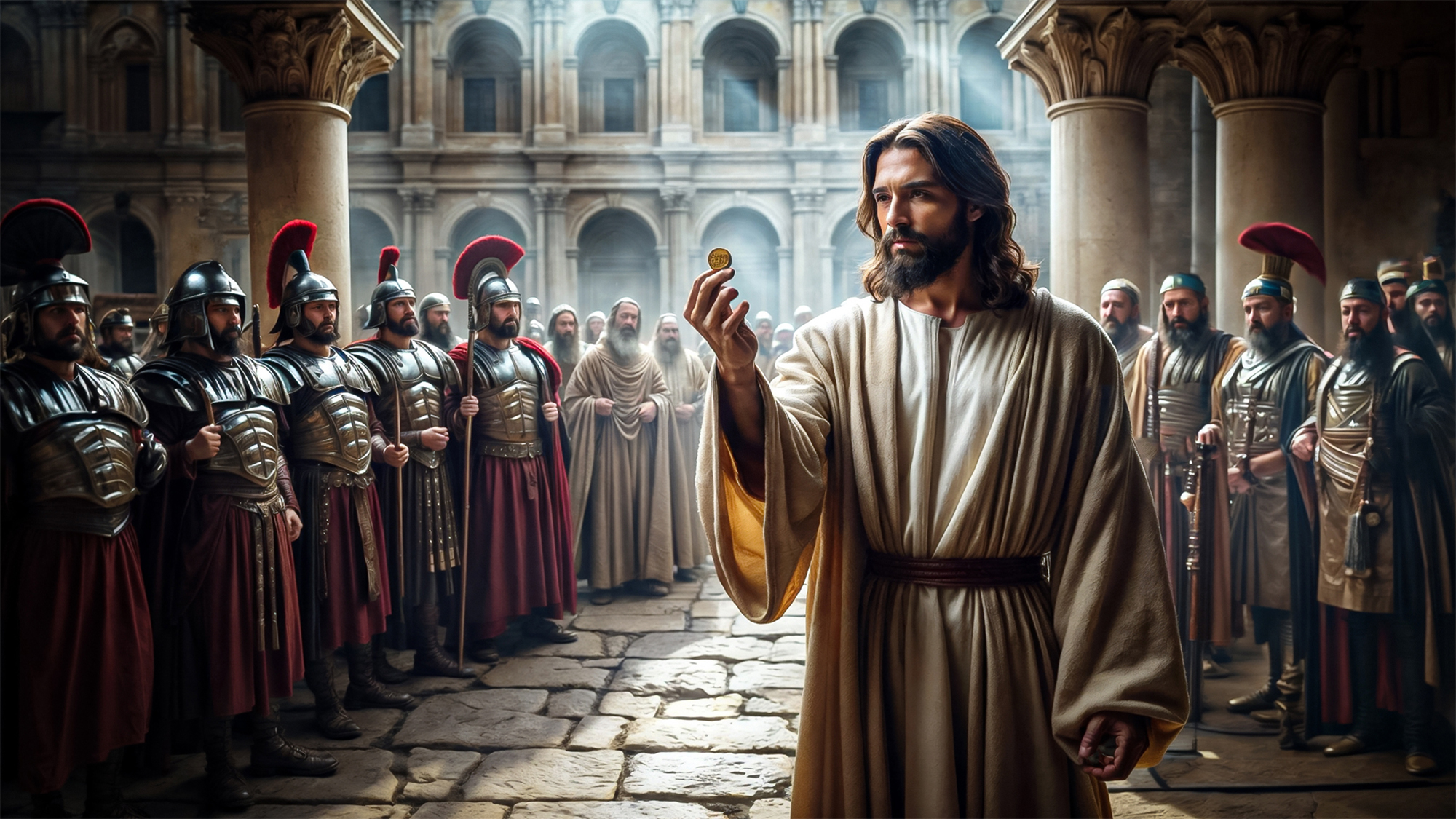 “Hey look, I found a coin!”
In essence, there are things delegated to Caesar, and there are other things not delegated to him. Relevant to this discussion, we may focus on these key points:
- Punishing evil is within Caesar’s domain;
- The church is not under Caesar’s rule.
Many quote from Romans 13 to pressure Christians into blanket submission under the government. We should back up to Romans 12 for more context, with specific focus on the chiastic progression that occurs at the end of the chapter. Below, the passage is laid out in the “A-B-C-D-C-B-A” structure.
[A] Do not repay evil for evil. Be careful to do what is right in the eyes of everyone.
[B] If it is possible, as far as it depends on you, live at peace with everyone.
[C] Do not take revenge, my dear friends…
[D] Instead, leave room for God’s wrath.
[C] For it is written: “It is mine to avenge; I will repay,” says the Lord.
[B] On the contrary: “If your enemy is hungry, feed him; if he is thirsty, give him something to drink. In doing this, you will heap burning coals on his head.”
[A] Do not be overcome by evil, but overcome evil with good.— Romans 12:17-21 (NIV)
From the outer layer, a discussion of evil is followed by how we should treat others, which then encases the commands to forgo our own vengeance, centring finally on the focal point of leaving room for the wrath of God. In a nutshell, there is an assurance of justice: though we are not to seek revenge (even if we’re victims of wrongdoing), God will take vengeance in lieu of us. This is revealed to be his duty, and so we may rest in the outworking of his wrath, while treating others with love.
Having grasped the context, we can then understand how God has delegated his duty of earthly justice — the punishing of evil — to Caesar, as outlined in Romans 13:
Let everyone be subject to the governing authorities, for there is no authority except that which God has established. The authorities that exist have been established by God. Consequently, whoever rebels against the authority is rebelling against what God has instituted, and those who do so will bring judgment on themselves.
For rulers hold no terror for those who do right, but for those who do wrong. Do you want to be free from fear of the one in authority? Then do what is right and you’ll be commended. For the one in authority is God’s servant for your good. But if you do wrong, be afraid, for rulers do not bear the sword for no reason.
— Romans 13:1-4 (NIV)
A fitting title for Caesar would be that he is God’s avenging servant. When we leave room for God’s wrath, it means that we can expect the government to fulfil its delegated role — punishing evil as means to maintain order. Anything else they do does not actually necessitate their existence.
But with governing bodies being mere servants of God, they do not have the authority to redefine what is good and what is evil on their own. The concerted effort to paint those who oppose COVID mandates as selfishly evil, for example, has given way to unjust punishments in recent years.
 Zero risks taken.
There are certainly limits to Caesar’s authority, or anyone’s authority, for that matter. If we must obey every single instruction prescribed by the government (apart from explicit sin), why not also obey every single command given by your pastor too in similar fashion?
Have confidence in your leaders and submit to their authority, because they keep watch over you as those who must give an account. Do this so that their work will be a joy, not a burden, for that would be of no benefit to you.
— Hebrews 13:17 (NIV)
It is interesting how we can instinctively see the limitations of delegated authority more easily within the church than in government. Such is the impact of the persistent incursions of statism.
Therefore, Romans 13 should not be wielded at Christians by tyrannical leaders as if the question of obedience to their every whim is settled. Rather, it should strike fear into the heart of every leader — of every husband, parent, pastor, and every ruler at whatever level of human government.
And make no mistake. The domain of church isn’t under Caesar’s rule; God has delegated authority to pastors and elders, with the practical assistance of deacons, to oversee his house. These are the ones who will be held accountable for the spiritual well-being of the congregation.
However, when church leaders hand over their authority to Caesar, especially in times when he rejects Christ’s authority and attempts to determine the functional parameters of the local church, they have succumbed to the encroachment of statism. For pastors and elders, this dereliction of the duty to shepherd souls is tantamount to idolatry, even if they are blissfully unaware.
May those that have failed God (and us) in this way reflect on their actions and seek repentance.
Part Three: Responding to a Biblical Understanding of Authority
We now know that Caesar is meant to be God’s avenging servant, who is called to reward good and punish evil. But what happens when Caesar starts rewarding evil and punishing good, as is typically the case in today’s political climate? And what about the gray areas (e.g. mask mandates), or other issues that, when we were blinded by statism, used to be non-issues (e.g. speed limits)?
In the case where Caesar is evil, two opposing responses are common. People either:
- Submit and obey, no matter what;
- Disregard his authority altogether.
Many pastors in Nazi Germany during World War II adhered to the first response. Hopefully, we now know well enough that this isn’t the way to go. But does that mean the second option is correct?
At the least, we must recognise that an evil Caesar is still Caesar. For if God can call a tyrant like Nebuchadnezzar “my servant”, then we should think twice before declaring “not my president” against someone who has risen to power, however unfavourably.
Christ’s willingness to do what was right while suffering unjustly should also serve as our example. Even in the face of unrighteousness, he did not sin, speak deceitfully, or issue threats; he simply entrusted himself to the Father, responding evil with good, leaving room for God’s wrath.
Woe to those who say that evil is good, and good is evil;
that dark is light, and light is dark;
that bitter is sweet, and sweet is bitter.— Isaiah 5:20 (NIV/NLT)
This isn’t a call to mindless submission under tyrannical rule. There are occasions when allowing mistreatment would be a righteous response; yet other times, a firm “no” would be most loving. Having said that, how do we then practically make wise decisions?
A good starting point would be to distinguish right from wrong, and acknowledge the many things that are neither in nor of themselves. Do not narrow the middle ground by assigning choices and behaviours as “good” or “evil” where Scripture is silent. Embrace the gray in freedom.
 Sanitising your faith.
Amid the quagmire of COVID decisions, remember to be motivated by love, directed by conscience. Look to church leadership for sound teaching of the Word, laying down the biblical principles that guide the path forward. However, do not expect pastors to tell you whether or not to put on a mask or to be vaccinated, lest they become as tyrannical as Caesar. Beware of legalistic gatekeepers.
Against further state-decreed breaches of freedom, know that there is room for pragmatism without compromise. Standing up to tyranny may result in honour, or it may result in persecution and harm. Always be ready to face consequences when preaching Jesus in a hostile world.
The apostles were brought in and made to appear before the Sanhedrin to be questioned by the high priest.
“We gave you strict orders not to teach in this name,” he said. “Yet you have filled Jerusalem with your teaching and are determined to make us guilty of this man’s blood.”
Peter and the other apostles replied: “We must obey God rather than human beings! The God of our ancestors raised Jesus from the dead — whom you killed by hanging him on a cross. God exalted him to his right hand as Prince and Saviour that he might bring Israel to repentance and forgive their sins. We are witnesses of these things, as is the Holy Spirit, whom God has given to those who obey him.”
When they heard this, they were furious and wanted to put them to death.
— Acts 5:27-33 (NIV)
What’s troubling about the whole COVID experience was when attacks came from fellow believers. For Los Angeles County in California (the author’s locality), there were churches that criticised and condemned those who boldly resisted Caesar’s tyranny. The churches that shut down, met outside, enforced masks and social distancing, and banned singing are now meeting indoors again without restrictions — not because the threat has changed, but because the very people that they criticised forced this issue through the courts until there was a Supreme Court ruling, which showed that the mandates were always illegal under the U.S. Constitution.
Yet there is seldom an example of any of these church leaders repenting or even apologising to the people whom they criticised. They are slow in admitting their error, but quick in benefitting from those they spoke out against. And if this is how American churches acted, what can we expect for Christians in nations without such a robust legal system protecting their rights to worship?
Therefore, think on these things biblically, and learn from history so as to not repeat it.