Intertain: Spotlight 03
Life is unpredictable; death is a certainty. What follows is the afterlife that awaits us all.
Before Your Eyes is a virtual reality narrative game exploring the short life of the recently-deceased Benjamin Brynn. He recounts his years to the underworld’s Ferryman through memories flashing before the eyes of the player, as they figure out how best to present his account to the Gatekeeper, who judges each and every soul and separates those worthy to enter paradise from others that are turned into seagulls and cursed to roam the dark, underworld river forevermore.
As someone who has thought about death since the age of five, and who laments failures in living this life, I found myself weeping a deluge of tears even still wearing the PSVR2 headset while at play. That sure complicated things, because eye-tracking is the only way through which players interact — having hands isn’t a prerequisite for this title. My emotions led to a messy, but memorable journey.
I decided to re-experience the tale with a few others, and to gather their thoughts.
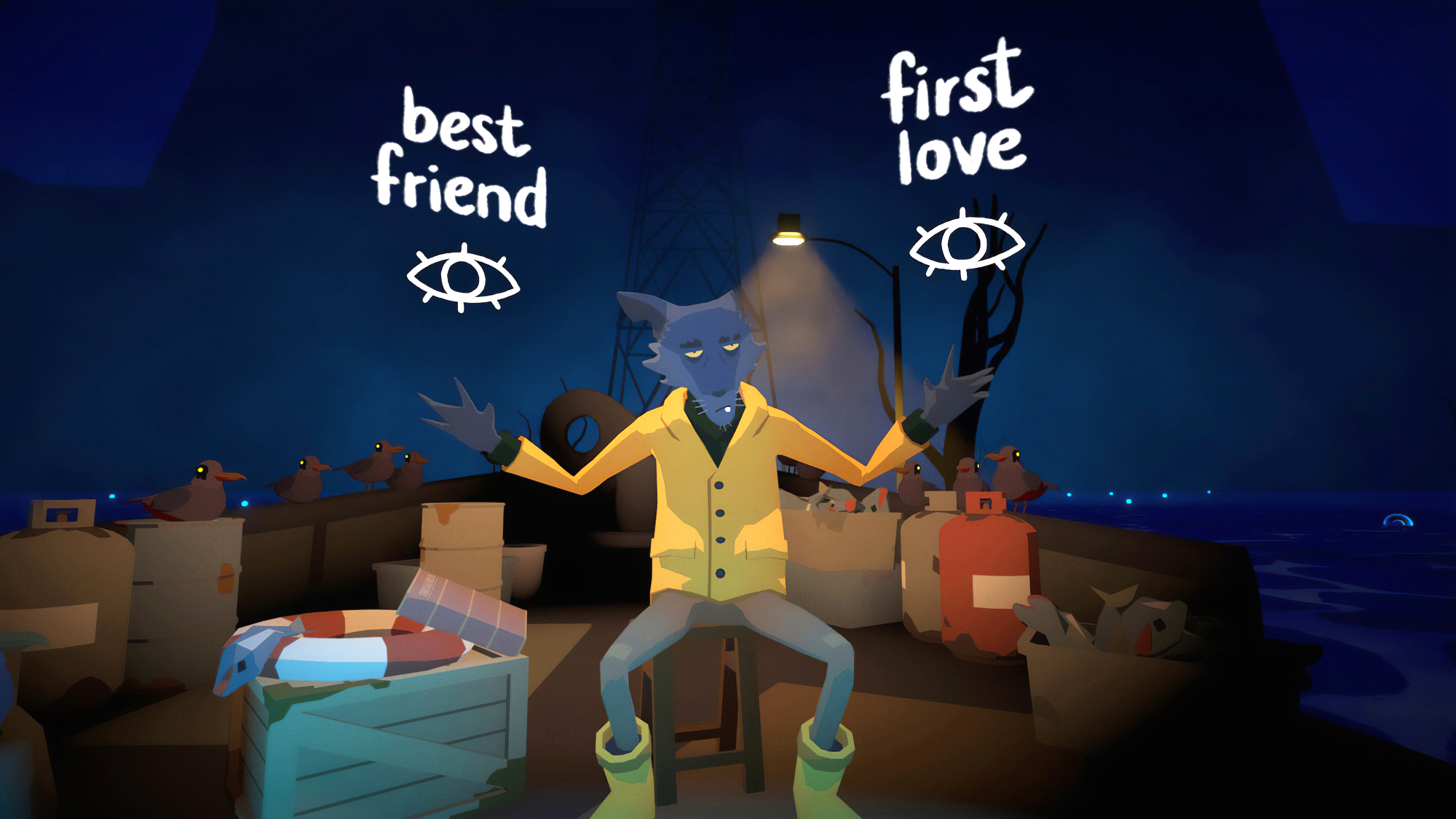 Seeing is believing.
Blink and You Shall Miss It
In some games, players tend to skip over mundane dialogue and tiresome cutscenes. But not all dialogue or cutscenes are made to be skippable, and therein lies the frustration.
Before Your Eyes may suffer a contrasting problem. In fact, most scenes are prematurely skippable: the characters would still often be in meaningful conversation when the option to move forward, which is triggered upon blinking, becomes active.
This simple, yet effective gameplay mechanic ties into the game’s theme; from a perspective beyond the mortal realm, our lives are seen as mere flashes — blink and you shall miss it. And yet, it is within these fleeting moments that we witness our true selves, from which our eternal destiny is revealed.
Trying to keep your eyes open in the VR headset is as futile as trying to live forever. Sooner or later, you will have to blink; sooner or later, we all have to move on.
The life of mortals is like grass, they flourish like a flower of the field.
The wind blows over it and it is gone, and its place remembers it no more.
— Psalm 103:15-16 (NIV)
- AYK: I am the type of OCD boy who needs to hear and understand every word when enjoying movies or games. So having that constant fear of missing out as I played this game was quite uncomfortable for me, and yet the mechanical poetry of it all made it worthwhile.
- SAM: The VR headset (with earphones) provided me an immersive experience. Refraining from blinking was a bit challenging, but I am satisfied with my overall performance, especially for managing to spell out “STAY HERE” in the night sky by connecting stars with my eyes.
- AUDEE: I needed a break mid-game to rest from dizziness, but persevered in the end.
- MAY: This game is tough for people like me with dry eye syndrome!
The Art of Changing Paths
As Benjamin unpacks his life to the Ferryman, a story of resilience and courage unfolds…
Little Benny is an imaginative boy who, under the influence of Elle (his mother) develops a keen ear for music at a young age. While Richard (his dad) worries about excessive pressure, Elle pushes her son to become a child prodigy, motivating him with wisdom passed down from her own father:
The only way to fight against time is to create a work of genius, which may live on after you are gone.
Dreams of being immortalised through musical creativity crashes to an abrupt end when Benny is rejected by a prestigious conservatory. In my mind, he probably got beat by some crazy Asian kid. Following the news, Benny is also diagnosed with an illness that keeps him home for a year.
During the downtime, the boy rediscovers his passion for drawing, which leads him into art school. Benny’s unique style garners him widespread attention over the years, as he becomes a true artist.
However, when Elle suddenly passes away, Benny isolates himself from the world, only able to paint variations of his mother’s final portrait. His slump persists until one day, he recovers sheets of music from sorting through Elle’s old belongings. Being reminded of their family’s love of music revitalises Benny’s artistic drive and empowers him to paint a new portrait of his mother — a masterpiece that he displays at his latest exhibition to much acclaim and honour.
 Benny’s very first friend.
Having followed Benjamin’s journey to its climax, the Ferryman howls in excitement at its apparent worthiness. Before him stands a soul of substance containing the inspired life of a successful artist; and now he simply needs to conjure up the best words, with the help of a trusty thesaurus in hand, aiming to convey such a memorable, stirring tale to the Gatekeeper.
- AYK: My personal creative journey has led me from music to architecture, to film, to writing, then back to music again after a long hiatus caused by failure. I understand the utter pain and struggle of losing a channel of self-expression, but also know the joy of discovering another creative outlet, or even of reviving a first love, as it has been the case for me with songwriting. Utilising these gifts for our eternal God is the best way to fight against time!
- SAM: I used to put much focus on material success. But within the past five years, I realised that there is a measure of success beyond worldly perspectives. So my attention shifted to building character, instead of my career — caring especially about how I treated people and examining my motivations. Growing up, it never felt natural for me to connect with others; therefore, nowadays I value these opportunities. In the game, I chose for Benny to spend precious time with his childhood friend, rather than always worrying about his piano progress.
- AUDEE: As the years go by, I am increasingly aware of my delay in getting married and starting my own family. At times, it can feel like this path has become a dead end, a disappointing failure. To avoid feeling alone, I have contemplated straying from the righteous route, into other options that would seemingly fulfil my longing for intimacy. Yet I understand it is my impatience and my unbelief leading me to these thoughts. So where God’s prescribed path is crystal clear, I can only pray that I am given the strength to persevere with much contentment and faith, remembering that God should be prioritised over everything else, even something as wonderful as marriage.
Escape from Harsh Reality
As the Ferryman rows his boat toward the Gatekeeper’s tower, he rehearses the speech that he has prepared about old Benjamin. But suddenly, the seagulls around them become increasingly rowdy.
“LIAR! LIAR! LIAR!” the birds squawk in pure chaos, overwhelming any attempt to silence them.
The Ferryman finally gives up and reveals that these winged creatures are actually the souls of liars, who are able to see through any tales woven with deceptive intent. He confronts Benny and urges him to come clean, lest he ends up a cursed seagull himself.
Back into the land of memories, we see the adolescent Benny diagnosed with a terminal disease. While bedridden, he takes up writing on his mother’s old typewriter. He records down his life story, and dreams about what he’d do once he recovers — becoming a famous artist is part of this fantasy.
Sadly, Benny’s condition does not improve. He soon relies on regular dosages of drugs and medical devices just to get through his remaining days. Crawling through the valley of death, he writes:
Benjamin Brynn was a loser…
He was the worst Brynn to ever live.
He didn’t even try to fight the disease inside him.
He just laid down and died.
Life does not always go the way that we want. At times, the pain causes us to escape into fantasies. But when worse comes to worst, embracing death may even seem like the ultimate escape.
- MAY: When I suffered from endometriosis, the pain was so persistent that I couldn’t do anything productive; even thinking was too strenuous. And so I just consumed fantasy novels to distract my mind until the painkillers started working, or until I was exhausted and simply passed out. When pain is intense, any bit of escape seems welcome.
- AYK: I come from a high-achieving family. My parents, along with many of my relatives, have all attained postgraduate degrees, or even PhDs. As for myself, I have but a measly diploma related to filmmaking, which I am not using. I haven’t had any official work in years, much less any sort of career. There is no doubt that from certain perspectives, I am the loser of my family — and like Benny, I am prone to escape from failures into fantasies.
 Life-ending or life-changing?
Honesty Paves the Way
The lives of mortals are but a blip compared to eternity, whether or not we stick around long enough to grow old. There is something to be said about appreciating quality over quantity when it comes to our days spent on earth, as the author of Ecclesiastes ruminated in his existential musings:
A man might have a hundred children and live to be very old. But if he finds no satisfaction in life and doesn’t even get a decent burial, it would have been better for him to be born dead. His birth would have been meaningless, and he would have ended in darkness. He wouldn’t even have had a name, and he would never have seen the sun or known of its existence. Yet he would have had more peace than in growing up to be an unhappy man. He might live for a thousand years twice over but still not find contentment. And since he must die like everyone else — well, what’s the use?
— Ecclesiastes 6:3-6 (NLT)
Toward the end of Benny’s extra-short life, he finds several redeeming experiences that bring some comfort and meaning to his fading existence. The first of which involves the return of the family cat, one that has lost all her kittens in a gruesome coyote attack. Secondly, Benny reconciles with his neighbour Chloe, whose mother passed away when she was little. They both know about loss.
Under Richard’s encouragement, Benny also plays one of Elle’s old piano compositions one evening, mending his mother’s broken heart. On the following day, she begins writing a new melody.
These seemingly small, yet meaningful moments finally make the Ferryman realise that a good life story isn’t about grand words or tales. Hurling his thesaurus into the water, he commits to delivering Benny’s humble journey with sincere honesty, celebrating the lasting impact of one ordinary child:
Benjamin Brynn was born into an ordinary home, to an ordinary mother and father, within a small town by the sea. His mother was a composer, or at least that’s what she dreamed she’d be. When her own dreams didn’t pan out, she began to dream for him.
But then, when he was just 11 years old, he got sick, and had to remain indoors for an entire year. And in that year, he began to worry that he hadn’t lived enough, and so he made up a story of the great life he thought he wanted to live, which only made him forget the great life he already had… how he had filled a new home with light and joy and promise; how he met one girl, his neighbour, who felt all alone in the world, and made her feel okay again; how, even when he was sick, he still gave his parents hope — how he reminded them of who they were, after they had almost forgotten.
So when Benjamin knew he was going to go, he was okay, because he had already lived a great life. A full life. And he was everything he needed to be. Just as he was.
Upon hearing the heartfelt summary of Benny’s short, but precious life, the Gatekeeper allows him through to paradise. He closes his eyes one last time, now with a peaceful smile on his face.
 A second chance.
- SAM: The helplessness of Benny suffering on his bed reminded me of the repentant thief beside Jesus at his crucifixion. In such desperate moments, all pretence fade away. The thief admitted his guilt and decided to trust Jesus, who was without sin. This humble faith reflected a child’s simple reliance; like Benny, honesty paved the way to being fully accepted.
- AUDEE: The more we compare to others, the more we see that life on earth is unfair. Yet before the Creator, we are all equally lacking, regardless of how long we lived, how much we achieved. What we do with what he has given us is more important than what we can selfishly hoard.
- MAY: The final sections of the game felt so sad, as the virus grew visibly stronger and ever more difficult to suppress. There was also a sense of guilt for losing the will to fight, which came with much uncertainty along the journey. In contrast to this, we are blessed to know Christ and enjoy his assurance of salvation in the present age. Knowing that we are already accepted, there is no need for us to craft tall tales to impress. The work of Jesus will suffice!
- AYK: I am grateful to have witnessed this example of how a seemingly unremarkable life can still impact others meaningfully. I may never amount to much in this life, but I take comfort in Jesus, who remembers the weak, the poor, and the heartbroken, not only in this age, but also in the age to come. I acknowledge May too (previously, my wife; presently, my sister), who has walked with me even in the darkest of times. “You changed me. You made me a better person,” she said to me after playing the game. “Your life is important to me, as well as to God.” Likewise, my dear sister, likewise. I wouldn’t even be alive today, if not for you.
Individual Participants [4]: Audee Gianda Budiman, Ayk Iano, May Chien, and Sam Nye.